

 Current location:
NEWS INFORMATION
Die Cast Aluminum Parts in Robotics and Automation Equipment
date:2026-09-27 14:50:04 click:174
Robotics is an unforgiving application for any material. A joint housing has to be stiff enough to hold gear alignment, light enough not to penalise payload, accurate enough to avoid bearing misalignment, and cheap enough to justify a machine that ships in hundreds rather than millions. That combination is why cast aluminium appears throughout the industry, from articulated arm segments to end-effector bodies and sensor mounts. The engineering logic is different from automotive lightweighting, and understanding it helps when specifying parts for automation equipment.
Moving Mass Matters More Than Static Mass
A robot arm does not care much about the weight of a stationary bracket; it cares enormously about the weight of anything that moves. Reducing mass at the distal end of an arm has a compounding effect — a lighter wrist allows a smaller forearm, which allows a smaller shoulder joint, which reduces cost through the entire kinematic chain. This is why structural castings in robotics concentrate on joint housings and link bodies rather than base plates. The benefit is cycle time as much as energy: less inertia means faster acceleration and shorter moves, which directly raises throughput on a production line. A few hundred grams removed from a wrist assembly can be worth real money over the life of a cell.
Joint Housings and Gearbox Cases
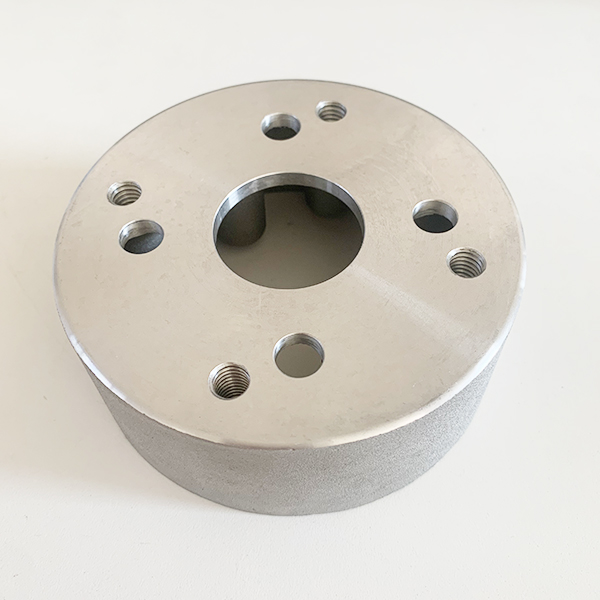
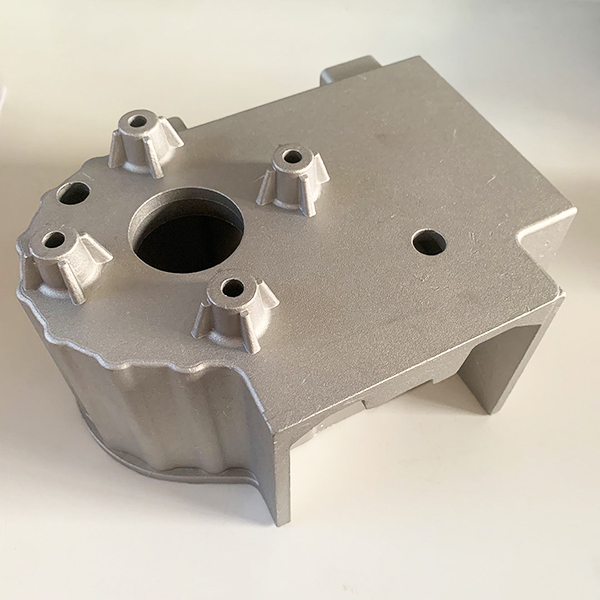
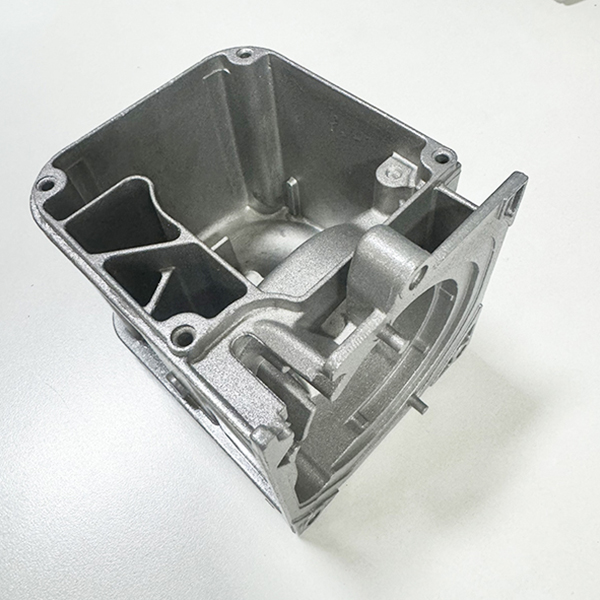
A joint housing carries bearing seats, a gearbox bore, motor mounting faces and cable pass-through, often in a single component. Cast aluminium suits it because all those features can be incorporated into one piece, and because critical bores can be machined to the accuracy gear alignment requires. The design trap is the bearing seat: a cast bore is not accurate enough to locate a bearing directly, so seats are machined from cored pilots with enough stock to clean up. Wall thickness around a bearing seat matters too — too thin and the bore deforms under press-fit load, which is a failure that shows up as noise and shortened bearing life rather than as an obvious break.
Stiffness, Damping and Repeatability
Aluminium has about a third of the stiffness of steel by modulus, so a cast part substituting for a steel one needs more section to match deflection. Geometry recovers most of that: ribs, box sections and curved shells give far more stiffness per kilogram than flat plate, and casting makes that geometry economical. Aluminium also has better damping than steel, which helps with vibration at the end effector and reduces the ringing that shows up as settling time after a fast move. Repeatability — the robot's ability to return to a taught point — is affected by anything that flexes under load, so the stiffness-to-weight ratio of cast link structures is a genuine performance parameter, not just a material property.
Cable Routing and Service Access
Automation equipment is dense with cables, and castings can either solve the routing or make it miserable. Cast-in channels, clips and pass-through holes cost almost nothing in tooling and eliminate a whole category of add-on hardware. Smooth radii at every cable exit prevent the abrasion failures that appear after months of flexing. Service access deserves the same attention: a housing that requires three hours of disassembly to replace a motor is a maintenance cost that dwarfs the casting's purchase price. Designing removable covers with machined sealing faces and captive fasteners keeps the assembly sealed while remaining serviceable — and it is a conversation worth having with the manufacturer before tooling, because access features affect draft, parting line and core design.
Heat From Motors and Drives
Servo motors and drive electronics generate heat in enclosures that are often sealed against dust and coolant mist. Cast aluminium helps twice here: it conducts heat away from the source, and it can be cast with external fins that increase surface area at no assembly cost. Thermal management in robotics is usually about protecting nearby components rather than the motor itself — encoder electronics and cabling are more temperature-sensitive than the motor winding. A machined thermal interface pad where a drive module contacts the housing wall is more effective than fins alone, and it is a feature easily built into a casting.
Volume Reality and Tooling Economics
Robotics and automation programs often run in tens to a few thousand units per year, which changes the calculus. A multi-cavity hardened tool might be hard to justify at that volume, while a single-cavity die with a well-planned maintenance schedule is entirely reasonable. This is where a supplier's flexibility matters: the ability to run a single-cavity tool, to machine in-house, and to hold inventory against a release schedule often matters more than maximum press capacity. Agreeing on how tooling cost is amortised, what happens if volume doubles, and whether the tool can be modified for a design revision should all be settled in the first commercial conversation.
What to Bring to a Casting Supplier
Supply the 3D model, annual volume and call-off pattern, which features are machined and to what tolerance, load cases or at least the mass being carried, any thermal load, and the interface standards used for motors and gearboxes. Ask whether the manufacturer machines in-house, whether it can support single-cavity tooling, and whether it holds dimensional capability data on machined features. Automation equipment rewards suppliers who can run mixed low-volume work reliably, which is a different capability from running one part forever.
References
International Organization for Standardization. (2011). ISO 10218-1: Robots and robotic devices - Safety requirements for industrial robots - Part 1: Robots. ISO.
International Organization for Standardization. (2016). ISO/TS 15066: Robots and robotic devices - Collaborative robots. ISO.
International Organization for Standardization. (1998). ISO 9283: Manipulating industrial robots - Performance criteria and related test methods. ISO.
International Organization for Standardization. (2004). ISO 9409-1: Manipulating industrial robots - Mechanical interfaces - Part 1: Plates. ISO.
ASTM International. (2018). ASTM B85/B85M: Standard Specification for Aluminum-Alloy Die Castings. ASTM International.
International Organization for Standardization. (2007). ISO 8062-3: Geometrical product specifications (GPS) - Dimensional and geometrical tolerances for moulded parts. ISO.






Botou Ruitai Die Casting Co., Ltd.
Copyright © 2026-202 https://www.ruitaidiecasting.com. All Rights Reserved Botou Ruitai Die Casting Co., Ltd.All rights reserved